
Saskatchewan’s Tech Ecosystem: A Guide for Skilled Newcomers
Published by Tech Career Bridge Network
Saskatchewan is quietly becoming one of Canada’s most compelling destinations for tech talent. Tech employment in the province grew 108.6% in computer system design since 2016, outpacing every other Prairie province. The broader tech sector added an average of 715 new jobs per year over that same period, and the provincial government’s Growth Plan aims to triple the sector by 2030 — a target it’s currently on track to exceed. For internationally trained professionals with permanent residency looking for a place where their skills are genuinely needed, where they can actually afford a home, and where the professional community is small enough that your contributions get noticed, Saskatchewan deserves serious consideration.
The province is home to 347 tech companies as of 2023, supporting over 5,400 workers earning an average of $83,000–$88,000 annually — well above the provincial average. Software company revenues grew 187% between 2016 and 2022. And with a provincial technology startup incentive offering investors a 45% tax credit — described as the most aggressive in Canada — the funding environment is becoming harder to ignore.
Two Cities, Two Research Parks, One Growing Corridor
Saskatchewan’s tech activity concentrates in two cities roughly 250 kilometres apart: Saskatoon (population ~320,000) and Regina (population ~260,000). Each anchors a dedicated research and technology park, both unified under Innovation Saskatchewan following a May 2025 rebrand.
The Saskatoon R+T Park sits adjacent to the University of Saskatchewan and has operated since 1980. It houses specialized labs, research greenhouses, and Saskatchewan’s only 5G Innovation Labs. The Regina R+T Park, established in 2000 beside the University of Regina, focuses on energy, environmental sciences, mining, and IT. Between them, the two parks host over 160 tech and research companies employing more than 3,900 people.
The Support Network That Makes the Ecosystem Work
What separates a cluster of companies from a genuine ecosystem is the connective tissue around it. Saskatchewan has built this deliberately over the past decade.
Co.Labs is the province’s first technology incubator, launched in 2017. It takes no fees and no equity. To date, it has incubated 228 startups, helped them raise $63 million in private investment, and supported the creation of 958 jobs. Cultivator, powered by Conexus, is Canada’s first credit union-led tech incubator, headquartered in Regina. Since 2019, it has supported nearly 200 startups and runs a specialized AgTech Accelerator program (more on that below). SaskTech, the provincial industry association, advocates for the sector and runs workforce development programs. Startup TNT was recognized by the CVCA as Canada’s most prolific pre-seed investor in 2023, with over 90 investments totaling $11.5 million. The annual Uniting the Prairies conference draws 650+ founders, investors, and community members from across the Prairie provinces each spring.
Companies That Are Hiring in Saskatchewan Tech
Vendasta is the province’s signature tech success story. Based in Saskatoon since 2008, the company builds an AI-powered commerce platform used by 28,000+ channel partners worldwide. With 400+ employees, Vendasta regularly lists software development, data engineering, and AI roles on its careers page.
Siemens EDA operates a Centre of Excellence at Innovation Place Saskatoon, recently doubling its space to 40,000 square feet and planning to double its team — a strong signal for semiconductor and EDA software talent. Coconut Software builds enterprise scheduling and video banking platforms for financial institutions including RBC, offers a four-day work week, and landed on Deloitte’s 2025 Technology Fast 500. Greenwave Innovations in Regina develops AI-powered energy management solutions. The Saskatchewan Research Council (SRC), Canada’s second-largest research and technology organization, employs over 400 scientists and engineers with active job postings in agriculture, mining, and environmental technology.
AgTech: Saskatchewan’s Global Competitive Advantage
This is the section to pay closest attention to — because if Saskatchewan has a single unfair advantage in the global tech landscape, it’s agriculture. The province contains more than 40% of Canada’s cultivated farmland — 40.3 million acres of cropland stretching across some of the most productive growing regions on earth. Saskatchewan is the world’s leading exporter of dry peas, lentils, durum wheat, canola oil, canola meal, mustard seed, and oats. It produces 91% of Canada’s lentils, 80% of its durum, 53% of its canola, and 76% of its mustard. In 2024, the province shipped $18.5 billion in agricultural exports to 153 countries.
All of this farmland is a vast, data-rich proving ground for agricultural technology. Technology proven here scales globally — and both companies and investors know it. The active innovation areas span the entire agricultural technology stack: precision agriculture (AI-powered drones for plant-level herbicide application), soil science and sensor networks (high-definition soil zone mapping), crop analytics and machine learning (training models on millions of crop images), remote sensing and geospatial analysis (hyperspectral imaging, LiDAR, and satellite data), farm management software (variable-rate application platforms), and biotech and plant genomics (genomic crop development, speed breeding, and advanced protein processing).
The provincial government backs this through the Agtech Growth Fund (AGF), administered by Innovation Saskatchewan, which provides non-repayable grants of up to $450,000 for novel agricultural technology solutions. The Cultivator AgTech Accelerator has supported 47 companies across three cohorts, helping them raise $119.2 million in private capital and create 193 Saskatchewan jobs. A fourth cohort launched in 2025, now including UK-based companies through a partnership with Innovate UK.
Major AgTech Employers: Global Companies, Saskatchewan Roots
Nutrien, the world’s largest crop input and services provider, has its registered headquarters in Saskatoon and is the province’s largest private-sector employer. Nutrien operates six potash mines in Saskatchewan, invests heavily in digital agronomy, and employs thousands of technical and operational staff across the province.
AGT Food and Ingredients, headquartered in Regina, is one of the world’s largest pulse-processing companies, exporting lentils, peas, chickpeas, and specialty grains to over 120 countries with $1.3 billion in annual revenue. Founded in Saskatchewan by CEO Murad Al-Katib, the company is a major employer in food processing and ingredient technology roles.
Bayer Canada runs a seed-breeding centre in Saskatoon and in 2023 signed a five-year MOU with the Government of Saskatchewan specifically focused on digital, smart, and precision farming — the first agreement of its kind in Canada. Syngenta Canada maintains Saskatoon operations serving Prairie producers across crop protection, seeds, and digital agriculture.
Agricultural Implements: Saskatchewan’s Innovation Manufacturing Cluster
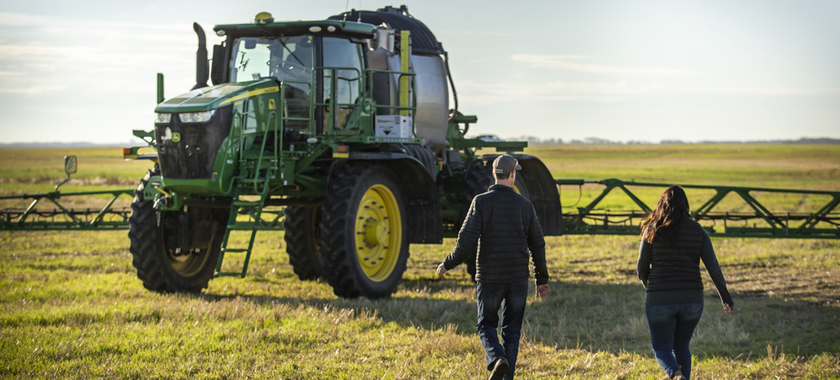
Saskatchewan is home to a remarkable concentration of world-class agricultural equipment manufacturers. These are not just factories — they are centres of R&D and engineering innovation, and many are actively hiring skilled engineers, software developers, and manufacturing technologists from around the world.
The Brandt Group of Companies, headquartered in Regina, is Canada’s largest privately owned company, employing over 6,000 people and serving markets in Canada, the United States, Europe, Australia, New Zealand, and Asia. Brandt manufactures agricultural spraying equipment, grain handling systems, and a full range of precision ag tools, and is the world’s largest privately held John Deere construction and forestry dealership with 180+ locations. Brandt Positioning Technology is also the exclusive Topcon Dealer in Western and Atlantic Canada for precision agriculture GPS and GIS solutions — a key employer for anyone with experience in geomatics, survey, or precision positioning technology. Brandt is a Platinum Club member of Canada’s 50 Best Managed Companies.
Bourgault Industries, headquartered in St. Brieux in northeastern Saskatchewan, is a leading global manufacturer of technologically advanced seeding and tillage equipment, with all R&D and manufacturing located in Saskatchewan. Bourgault is at the forefront of agricultural equipment innovation with its newly released Bourgault Intelligent Control (BiC) system — a sophisticated software platform integrating variable-rate application, sectional control, and precision metering. The company was named a Saskatchewan Top Employer in 2024 and is a proven employer of internationally trained workers through partnerships with Saskatchewan Polytechnic’s Innovative Manufacturing program. Open roles span design engineering, software development, C#/.NET automation, CAD/SolidWorks, FEA analysis, and manufacturing technology. Jobs available at bourgault.com.
Vaderstad Industries (formerly Seed Hawk) is based in Langbank, Saskatchewan — a small rural community that has become a global centre of seeding technology. Founded in 1992 by Saskatchewan farmer Pat Beaujot, Seed Hawk pioneered no-till and minimum-till seeding technology and developed innovations like the Sectional Control® Technology, iCon® Wireless Control System, and Fenix III precision metering that have shaped precision seeding globally. Acquired by Swedish company Väderstad in 2013, the Langbank facility now employs 250+ people and has been a Saskatchewan Top Employer for multiple consecutive years — a remarkable achievement for a rural operation. The company is a compelling example of world-class technology coming from small-town Saskatchewan.
Bourgault Tillage Tools (BTT), also based in St. Brieux, is an independent world leader in field opener technology with a dealer network spanning 500+ locations. BTT manufactures ground-engaging tools for seeding, tillage, and fertilizer application and is expanding into precision weed control technology for both conventional and organic farmers. With 84+ employees in Canada and the US, BTT is a growing employer in agricultural manufacturing and R&D.
Prairie Agricultural Machinery Institute (PAMI) in Humboldt provides independent engineering R&D and testing for agricultural and autonomous equipment, recently receiving $5 million in joint federal-provincial funding. PAMI is an ISO 9001:2015-certified organization and a recognized leader in applied research — an important employer for mechanical engineers, test engineers, and anyone with a background in equipment design or agricultural systems.
Biotech, Plant Genomics, and the Protein Economy
Beyond equipment and precision agriculture, Saskatchewan is building a significant biotech and plant-based protein ecosystem that is creating an entirely new wave of high-skill employment opportunities.
Protein Industries Canada, headquartered in Regina, is one of Canada’s five federally designated Global Innovation Clusters. It leads a national initiative — the Road to $25 Billion — to grow Canada’s plant-based food, feed, and ingredient sector. Saskatchewan crops (peas, lentils, canola, chickpeas) sit at the heart of this agenda. Protein Industries Canada funds collaborative projects between companies and research institutions, creating demand for food scientists, biochemists, data analysts, and processing engineers across the province.
Ag-West Bio, Saskatchewan’s bioscience industry association established in 1989, acts as a catalyst to link research capabilities with commercialization in agriculture biotechnology, bioproducts, and agri-food innovation. Its Global Agri-Food Advancement Partnership (GAAP) combines venture capital with long-term incubation in world-class R&D facilities — providing lab access, greenhouse space, and expert mentorship for early-stage biotech companies.
The University of Saskatchewan’s College of Agriculture and Bioresources hosts 26 research chairs, the Global Institute for Food Security (GIFS), the Crop Development Centre — one of the world’s most productive public plant breeding programs — and the Canadian Light Source, Canada’s only synchrotron, which enables advanced materials and protein analysis for agricultural breakthroughs. The Vaccine and Infectious Disease Organization (VIDO), also on campus, is one of the world’s largest high-containment facilities with extensive vaccine manufacturing infrastructure — creating employment for highly specialized biomedical scientists and engineers.
The Saskatchewan Food Industry Development Centre in Saskatoon recently opened a new fermentation facility — part of a wave of investment in plant-based ingredient processing. This facility provides companies with access to fermenters ranging from 10 to 10,000 litres for developing new plant-based foods and ingredients from Saskatchewan crops. It’s creating demand for food science, fermentation technology, and process engineering expertise that didn’t exist in the province a decade ago.
Croptimistic Technology (SWAT MAPS), based in Saskatoon, has built an international precision agriculture platform for high-definition soil mapping and variable-rate farming. The company recently launched SWAT Labs, its own in-house soil analysis facility, and was named a Saskatchewan Top Employer in 2026. It is an example of the kind of agtech company that could only have been built in Saskatchewan — grounded in deep agronomic knowledge and surrounded by the farmland that makes high-resolution soil science commercially viable.
The Roles This Ecosystem Needs Most
If you’re scanning for alignment between your skills and Saskatchewan’s demand, here is where the market is pulling hardest:
- Software developers and engineers — the perennial backbone of the sector, needed everywhere from SaaS companies to agricultural equipment manufacturers
- Embedded systems and firmware engineers — with Bourgault, Vaderstad Industries, and PAMI all developing sophisticated on-machine control systems
- Data scientists and ML specialists — particularly for crop analytics, yield prediction, and AI-driven input optimization
- GIS and remote sensing analysts — a distinctive Saskatchewan need driven by the scale of precision agriculture and soil mapping operations
- IoT and sensor engineers — soil monitoring, grain storage sensors, connected farm equipment, and variable-rate input systems
- Agronomists with a technology background — the hybrid role that every agtech company struggles to fill
- Mechanical and agricultural engineers — for equipment manufacturers like Brandt, Bourgault, Vaderstad Industries, PAMI, and Bourgault Tillage Tools
- Food scientists and process engineers — for the growing biotech, fermentation, and protein processing sector
- Plant biologists, genomicists, and bioinformaticians — for USask research institutions, GIFS, and the Crop Development Centre
- Product managers and technical sales — with domain expertise in agriculture or food systems
- Government and research sector roles — at Innovation Saskatchewan, SRC, the Saskatchewan Ministry of Agriculture, and federal research programs
Infrastructure Built for Tech
SaskTel, the provincially owned telecom, invested $398.5 million in capital infrastructure in 2024–25, including $130 million on wireless (primarily 5G expansion) and $108 million on its fibre-to-the-premises program. The result: 88% of Saskatchewan’s population now has 5G coverage across more than 700 converted wireless sites, with speeds up to 1.2 Gbps. SaskTel’s infiNET fibre network reaches 111 communities and covers 77% of homes and businesses, with a Rural Fibre Initiative targeting 85% provincial coverage. For 2025–26, the company has committed $465.9 million in further investment. Reliable rural connectivity matters enormously for agtech deployment — and Saskatchewan has made it a priority.
Your Dollar Goes Further Here
Here is the arithmetic that matters most for someone weighing a move. A software developer in Saskatchewan earns roughly $75,000 — about 10–13% less than the $85,000 average in Toronto or Vancouver. But the cost of living, especially housing, tells a completely different story.
The benchmark home price in Regina sits around $335,000. In Toronto, it’s $936,000. In Vancouver, $1.1 million. That means a Regina home costs roughly one-third of a Vancouver equivalent. Rent follows the same pattern: a one-bedroom apartment in Regina or Saskatoon runs $1,100–$1,250 per month, compared to $2,400+ in Toronto and $2,500+ in Vancouver.
A developer earning $75,000 in Regina faces a home price-to-salary ratio of roughly 4.5x. The same developer earning $85,000 in Toronto faces a ratio of 11x. Homeownership — the single biggest wealth-building tool for newcomers — is 2.4 times more attainable in Saskatchewan relative to income.
A Province Still Building
Saskatchewan’s tech and agtech ecosystem doesn’t have the name recognition of Toronto’s or Vancouver’s — and that’s precisely the point. This is a community where 347 tech companies, a manufacturing cluster building products sold on every continent, a globally significant agricultural biotech sector, and a handful of dedicated support organizations are building something with genuine momentum. The support infrastructure exists. The capital is flowing. The connectivity is real. The cost of living makes it possible to build a life, not just a career. For skilled newcomers willing to look past the obvious destinations, Saskatchewan offers something increasingly rare in Canada: room to grow.
Key Resources and Links
Ecosystem & Support Organizations
- Innovation Saskatchewan
- Co.Labs Tech Incubator
- Cultivator Powered by Conexus
- Cultivator AgTech Accelerator
- SaskTech Industry Association
- Startup TNT
- Uniting the Prairies Conference
- AgF — Agtech Growth Fund
- Ag-West Bio
- Protein Industries Canada
Tech Companies
- Vendasta (Saskatoon)
- Siemens EDA Saskatoon
- Coconut Software
- Greenwave Innovations (Regina)
- Saskatchewan Research Council — Careers
AgTech & Agriculture Companies
- Nutrien
- AGT Food and Ingredients
- Brandt Group of Companies
- Bourgault Industries — Careers
- Vaderstad Industries (formerly Seed Hawk)
- Bourgault Tillage Tools
- Prairie Agricultural Machinery Institute (PAMI)
- Croptimistic Technology / SWAT MAPS
- Bayer Canada Crop Science
- Syngenta Canada
- Federated Co-operatives Limited
Research & Biotech
- University of Saskatchewan — AgTech Research
- College of Agriculture and Bioresources
- Global Institute for Food Security (GIFS)
- Vaccine and Infectious Disease Organization (VIDO)
- Saskatchewan Food Industry Development Centre
- Saskatchewan Research Council (SRC)
Published by Tech Career Bridge Network. Data current as of February 2026. All links verified at time of publication.